
WHAT YOU NEED TO KNOW
When searching for the true Moneyline Meaning: How to Read the Simplest Bet, the essential rule is that you are wagering strictly on which team or competitor will win a matchup, with no point spread or margin of victory requirements to consider.
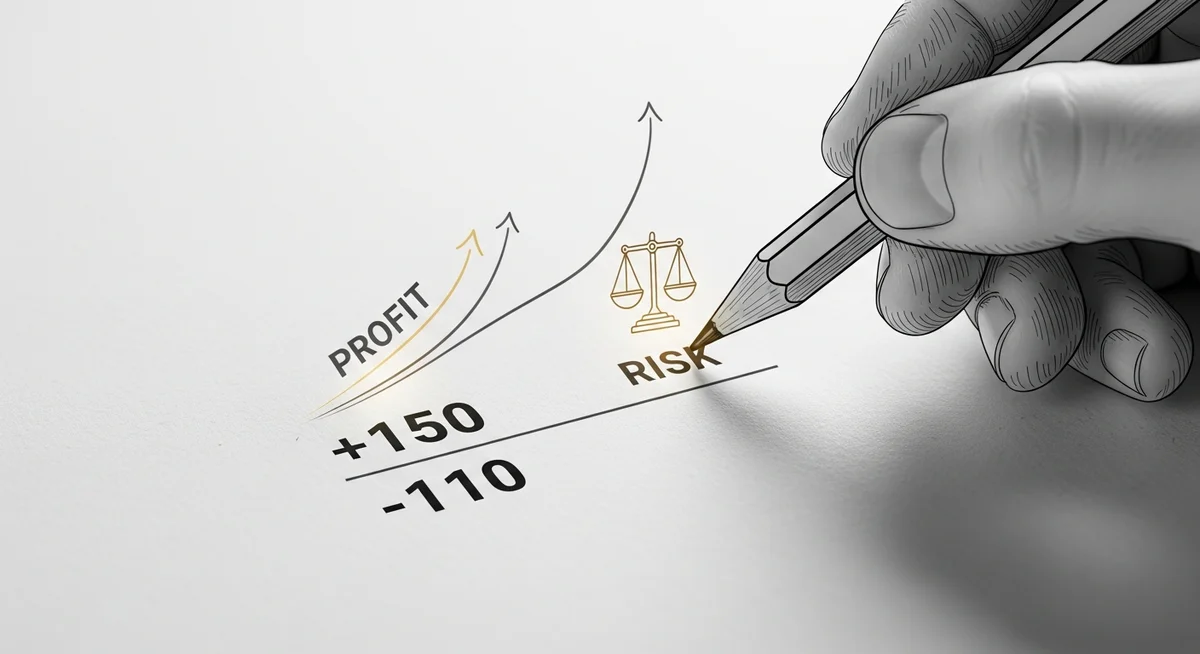
- Favorites are designated with a minus sign (-), which displays the exact amount you must wager to win $100 in net profit.
- Underdogs are marked with a plus sign (+), representing the exact amount of profit you will return on a successful $100 bet.
- As of 2026, sports wagering is legal and regulated in 39 US states and the District of Columbia, allowing bettors access to transparent, licensed markets.
- Every moneyline price contains a built-in bookmaker margin, meaning the combined implied probabilities of both sides will always exceed 100%.
Your long-term success relies entirely on identifying when the true probability of an outcome is higher than the implied probability calculated from the sportsbook’s listed odds.
What Is the Moneyline Meaning: How to Read the Simplest Bet?
A moneyline wager is the most fundamental transaction in the sports betting industry. When you place this bet, you are simply selecting which competitor or team will win the contest. If your chosen side wins, the bookmaker pays out your winnings, but if your selection loses, your stake is lost. Unlike point spreads, there is no requirement for a team to win by a specific margin or protect a handicap.
This betting style is the standard market format for lower-scoring sports. While sports like American football and basketball rely heavily on point spreads, sports like baseball, soccer, hockey, and individual combat sports are dominated by moneyline markets. The simplicity of this option makes it highly accessible, yet it requires a firm grasp of implied probability to navigate responsibly.
As of 2026, regulated sports betting is highly accessible across North America and Europe. Currently, 39 US states along with the District of Columbia permit regulated sportsbooks to operate. This structured environment ensures consumer safety, which is a major focus for global regulators such as the UK Gambling Commission. To review our operating standards, you can read our Legal Notice.
How to Read Moneyline Odds
Reading sports betting odds requires understanding the numeric values posted by bookmakers. In the United States, these values are predominantly shown in the American odds format, which centers around the figure of $100. This baseline figure serves as the scaling unit for both risk and reward, depending on whether you are backing the favorite or the underdog.
Understanding Favorites (-) and Underdogs (+)
- The Favorite (-): The competitor expected to win is always designated with a minus sign. For example, if a team is priced at -150, this indicates you must risk $150 to generate a profit of $100. If they win, you receive your original $150 stake back plus the $100 profit.
- The Underdog (+): The competitor expected to lose carries a plus sign. If a team is priced at +130, it means a $100 wager will return a profit of $130 if they secure the upset. A winning wager returns your $100 stake along with the $130 profit.
- The Implied Probability: You can convert these numbers into percentages. For a favorite at -150, the formula is
150 / (150 + 100), resulting in a 60% implied probability of winning. For an underdog at +130, the formula is100 / (130 + 100), which equals a 43.48% implied probability.
What Is a Pick ‘Em?
In some matchups, the bookmaker determines that the competitors are so evenly matched that there is no distinct favorite or underdog. This scenario is designated as a pick ’em, often abbreviated on betting boards as PK or listed with equal odds such as -110 on both sides. In a true even-money scenario with no bookmaker commission, the odds would be +100 for each competitor.
However, commercial sportsbooks must charge a commission to facilitate the wager. This commission, commonly referred to as the vig or juice, is why you often see both sides of an even matchup priced at -110. This pricing structure requires you to risk $110 to win $100 on either side, ensuring the sportsbook secures a profit margin regardless of which competitor wins.
How Moneyline Payouts Work
Payouts are mathematically tied to the odds listed at the exact moment you place your wager. Once your bet is accepted, your potential payout is locked in, regardless of how the market odds shift before the game begins. Understanding the math behind these payouts prevents unexpected surprises when wagers are graded.
What Does a Plus (+) Moneyline Mean?
A positive moneyline indicates how much net profit you will earn on a successful $100 stake. To calculate your payout for any positive moneyline, you can use a basic algebraic formula. Multiply your stake by the odds divided by 100.
For example, if you place a $50 wager on a team with odds of +180, the calculation is 50 * (180 / 100). This equates to a $90 net profit. When your wager wins, the sportsbook returns your original $50 stake plus your $90 profit, resulting in a total payout of $140.
What Does a Minus (-) Moneyline Mean?
A negative moneyline represents how much capital you must risk to secure a $100 net profit. To determine the profit on any negative moneyline, divide 100 by the absolute value of the odds, then multiply the result by your stake.
For example, if you wager $75 on a favorite priced at -150, the formula is 75 * (100 / 150). This calculation yields a net profit of $50. If the favorite wins, your sportsbook account is credited with your original $75 stake plus the $50 profit, totaling $125.
Moneyline Bets vs. Point Spread Bets
While moneylines require you to pick the outright winner, point spreads introduce a handicap to level the playing field between unequal teams. In point spread betting, the favorite must win by more than a designated number of points for the wager to pay out. Conversely, the underdog can lose the game outright but still win the wager if they keep the final score within the specified margin.
This fundamental difference changes how risk and pricing are distributed. On the moneyline, the risk is adjusted through varying payouts and odd values. On the point spread, the payout is typically kept near even money, while the risk is adjusted by changing the point handicap. The following table highlights the operational differences between these two foundational bet types.
| Feature | Moneyline Wagers | Point Spread Wagers |
|---|---|---|
| Primary Objective | Predict the outright winner of the game. | Predict the winner after point adjustment. |
| Payout Structure | Highly variable based on perceived risk. | Standardized, usually near even money. |
| Key Drawback | High risk on favorites; high variance on underdogs. | A team can win the match but lose the wager. |
| Ideal Sports | Baseball, hockey, soccer, combat sports. | Basketball, American football. |
Two-Way vs. Three-Way Moneylines
When browsing sportsbooks, you will find both two-way and three-way moneyline markets. A two-way moneyline is the standard offering for sports where a draw is highly unlikely or impossible, such as baseball, basketball, and tennis. In these markets, there are only two possible outcomes, and if the match somehow ends in a tie, the bet is graded as a push and your stake is returned.
In contrast, a three-way moneyline is common in sports where regulation ties are regular occurrences, such as soccer or hockey. This market offers three explicit betting options: Team A wins, Team B wins, or the match ends in a draw. If you bet on Team A to win on a three-way moneyline, and the match ends in a 1-1 draw, your wager is graded as a loss because you did not select the draw option.
When Does It Make Sense to Bet the Moneyline?
Opting for a moneyline bet is highly logical in situations where you believe an underdog is undervalued by the market. Since underdogs offer plus-money payouts, you do not need to win 50% of your wagers to remain profitable. Successfully picking a few well-researched underdogs can offset multiple losses, offering a sustainable path for disciplined bettors.
Conversely, backing heavy favorites on the moneyline requires extreme caution. If you consistently back favorites at odds of -400, you must win more than 80% of your wagers just to break even. A single unexpected upset can wipe out the profits accumulated from several consecutive wins, which highlights the high risk associated with heavy favorite betting.
According to research highlighted by GamCare, understanding the math behind sports odds is one of the most effective measures to prevent problem gambling behaviors. Maintaining an objective, mathematical approach prevents bettors from treating sports betting as a guaranteed income stream. To review our site data policies and user resources, please refer to our Privacy Policy.
Tips and Strategies for Moneyline Betting
- Compare Market Prices: Different sportsbooks set slightly different prices for the same matchup. Shopping for the best line, such as getting -110 instead of -115, directly reduces your transaction costs over time.
- Analyze the Built-in Margin: Calculate the implied probability of both sides to find the bookmaker’s overround. Lower overrounds mean the sportsbook is taking a smaller cut, leaving more value for the player.
- Leverage Underdog Value: Focus your analytical research on finding competitive underdogs in low-scoring sports. Small factors such as starting pitchers, weather conditions, or travel schedules can easily sway a single-game outcome.
- Set Strict Deposit Limits: Responsible operators always offer safety tools. Utilize these limit-setting utilities to enforce budget discipline and insulate your bankroll from emotional decision-making.