
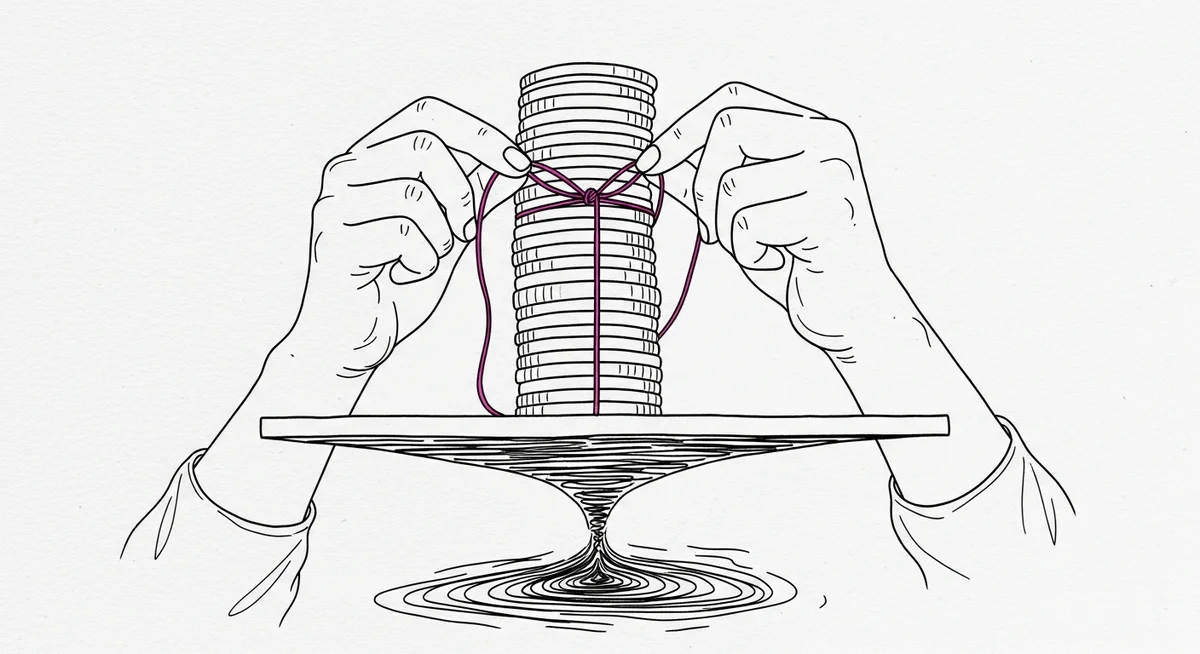
Hedging a bet guarantees a return by backing the opposing side of an active wager, but it reduces your long-term expected value due to the bookmaker’s margin.
- The core mechanic of hedging a bet: when and how to lock in profit involves securing a clean opposite market outcome, such as a two-way moneyline or a binary yes or no proposition.
- Placing a second wager always incurs a sportsbook hold, typically 4% to 6% per market, which extracts premium value from your overall portfolio.
- This strategy is highly effective for protecting large payouts, such as a five-leg parlay where four legs have already won.
Whether you should hedge depends entirely on your personal risk tolerance and bankroll size, as holding your original position remains the mathematically superior choice for overall yield.
What Is Hedging a Bet: When and How to Lock In Profit?
Hedging a bet is the practice of placing a wager on a different outcome from your original bet to reduce risk or secure a guaranteed payout. This trading strategy is deployed when the odds of your original bet have improved significantly, creating a window where you can limit exposure. While it acts as a form of insurance, it represents a direct trade-off between risk reduction and your potential return on investment.
The financial mechanics of a hedge rely entirely on the shifting probability of the event. If your original position increases in value, the market price of the opposing outcome will rise as well. By placing a mathematically calculated stake on that opposing outcome, you construct a scenario where you win one of the two wagers, leaving you with a known financial result regardless of the game’s final whistle.
How does hedging differ from arbitrage betting?
Arbitrage betting and hedging both involve betting on multiple outcomes to lock in returns, but they occur at different stages of the market lifecycle. Arbitrage targets price discrepancies across different sportsbooks at the exact same moment, allowing you to secure immediate value. Hedging relies on market movement over time, reacting to new information, injuries, or in-game events that alter the initial probability.
Because hedging occurs over an extended timeframe, it carries temporal risk that arbitrage does not. You must wait for the market to move in your favor before a hedging opportunity even exists. If the market moves against your initial selection, hedging can only be used to mitigate your losses rather than secure a profit.
Why should you hedge your bets?
How do you hedge to guarantee a profit?
- Capture shifting odds: When your selected team’s odds shorten dramatically, the opposing side’s odds increase, opening a profitable arbitrage-like window.
- Eliminate variance: By locking in a payout, you remove the unpredictable elements of sports, such as late referee decisions, injuries, or sudden momentum shifts.
- Exit a market early: Hedging allows you to settle your financial position before the event concludes, freeing up bankroll for other opportunities.
The mathematical objective of guaranteeing a profit is to ensure your total return from either winning outcome exceeds the combined stakes of both bets. This is highly common in futures markets or deep tournament runs. According to the UK Gambling Commission, understanding the exact financial obligations of any wager is central to personal safety and bankroll protection.
How do you hedge to reduce risk and protect your bankroll?
- Mitigate bad news: If key personnel suffer injuries before kickoff, hedging on the opponent can prevent a total loss of your stake.
- Control down-side exposure: When odds drift against your original prediction, you can place a smaller opposing bet to recover a portion of your initial capital.
- Maintain emotional control: Reducing the financial swings of active wagers prevents high-stakes anxiety, keeping your trading decisions analytical.
Using a hedge as a defensive tool is common when initial assumptions about a match are proven wrong. For instance, if you backed a tennis player who shows visible physical distress during warmups, hedging immediately limits your exposure. Responsible operators and advice organizations like GamCare advocate for these risk-reduction tactics to prevent emotional chasing.
When should you hedge your bet and when should you hold?
What are the three essential criteria for hedging?
- A clean opposite market exists: The event must have a binary outcome with no draw or multi-way complications, like a clean head-to-head tennis match.
- Original odds have improved significantly: Your initial position must hold substantial closing line value compared to the current market prices.
- You accept the cost of expected value: You must be comfortable paying the sportsbook commission on the second wager in exchange for certain protection.
Attempting to hedge in a multi-way market, such as a golf tournament with 120 competitors, is highly inefficient. The combined bookmaker holds across multiple selections will quickly erode any potential return. Before exploring advanced trading systems, reviewing foundational concepts on The Odds Desk can help structure your strategy.
Why does maximizing expected value conflict with minimizing risk?
- The cost of the vig: Every hedge bet is placed against a sportsbook market that includes a theoretical hold, meaning you pay a premium to place the second bet.
- Negative expected value: Unless you find an mispriced line, the hedge bet itself is a negative expected value transaction.
- Long-term yield reduction: Repeatedly hedging your positions will statistically lower your total net return over a sample of 100 or more similar bets.
Mathematically, if you have a positive expected value bet, the optimal strategy is to hold your position and let the event play out. Hedging converts a high-variance, high-yield opportunity into a zero-variance, lower-yield outcome. Data from GambleAware shows that managing expectations around short-term variance is essential for sustainable, long-term bankroll safety.
How to calculate and structure your hedge
Strategy 1: The Equal Profit Hedge (Locking in Guaranteed Returns)
- The goal: Secure the exact same net profit regardless of which side wins the event.
- The formula: Hedge Stake = Total Potential Payout of Original Bet / Current Decimal Odds of opposing outcome.
- The execution: Place the calculated hedge stake on the opposite side at the current market price.
Let us look at a worked calculation for a 2026 championship event. You have a pending $100 wager on Team A at odds of +1000 (decimal 11.00), which yields a potential payout of $1,100. Team A reaches the final, and Team B is priced at -110 (decimal 1.91). To find the equal profit hedge, divide the $1,100 payout by 1.91, resulting in a required hedge stake of $575.92 on Team B.
If Team A wins, your payout is $1,100. Subtract your original $100 stake and the $575.92 hedge stake, leaving a net profit of $424.08. If Team B wins, your hedge payout is $1,100 ($575.92 * 1.91). Subtract the same stakes to receive a net profit of $424.08, guaranteeing your return.
Strategy 2: The Break-Even Hedge (Refunding Your Original Stake)
- The goal: Erase all financial risk by ensuring you get your original stake back if the first bet loses, while keeping maximum upside on your original selection.
- The formula: Hedge Stake = Original Stake / (Current Decimal Odds of opposing outcome – 1).
- The execution: Risk only the minimum amount needed to cover your initial outlay.
Using the previous 2026 scenario, your original stake is $100 on Team A, and Team B is priced at -150 (decimal 1.67). To calculate the break-even stake, divide $100 by 0.67 (which is 1.67 – 1). The required hedge stake on Team B is $149.25.
If Team A wins the championship, you receive your $1,100 payout. Subtracting your $100 original stake and the $149.25 hedge stake leaves you with $850.75 in net profit. If Team B wins, your hedge bet pays out $249.25 ($149.25 * 1.67), which exactly covers your $100 original loss and your $149.25 hedge stake, resulting in a net profit of $0.00.
Strategy 3: Partial Hedging (Custom Risk Sizing)
- The goal: Find a middle ground between locking in equal profit and letting the entire bet ride.
- The formulation: Determine what percentage of the potential loss you want to cover, and scale the hedge stake accordingly.
- The execution: Execute a smaller hedge bet, ensuring some profit is preserved while keeping a larger portion of the original upside active.
This approach is highly customizable based on real-time confidence levels. For instance, if you wish to guarantee only a $200 profit while keeping the remaining upside, you can adjust your hedge calculator parameters to match this specific limit. It represents a practical middle path for cautious bettors who still want to back their original analysis.
Real-World Hedging Examples
Hedging a Futures Bet
- Scenario: You placed a pre-season futures bet on a team at +5000 to win their conference.
- Development: The team advances to the conference final, where they are listed as +150 underdogs.
- Execution: You hedge by betting the favored opponent to win the single game, securing a payout months after your initial investment.
Futures bets offer the largest price shifts, making them the most common candidates for a structured hedge. Because odds move from +5000 down to short numbers over several months, the spread between your initial price and the current market is vast. This allows you to secure substantial returns relative to your original unit size.
Hedging the Final Leg of a Parlay
- Scenario: You have a five-leg parlay with $50 at total odds of +3000, and the first four legs have successfully won.
- Development: Only a Monday night football game remains, with your final selection priced at -200.
- Execution: You place a hedge bet on the opposing team at +170 to lock in a return before kickoff.
Parlay hedging is a classic execution of risk reduction when facing a binary final leg. If the final game has a clear opposite market, you can calculate an equal-profit or break-even wager. This removes the risk of losing the entire multi-bet ticket on a single late-game variable.
Live Betting and In-Game Hedging
- Scenario: You bet on Team A at +150 before the match starts.
- Development: Team A scores an early goal, causing their live odds to shorten to -300 while Team B drifts to +250.
- Execution: You place a live bet on Team B at +250 to capture the in-game volatility.
- Mitigation: Be aware of live delay feeds and rapid market suspensions which can impact execution.
In-game markets move rapidly, requiring swift calculations to exploit. Live hedging demands discipline, as delay times of 5 to 10 seconds on sportsbooks can prevent you from locking in the desired price. It is essential to use automated calculators to avoid manual errors during fast-paced play.
Hedging vs. Cash Out: Why Sportsbook “Cash Out” Offers Cost You Money
- Built-in bookmaker margins: Cash-out features use proprietary algorithms that apply an additional hold, often charging 10% to 15% of your theoretical equity.
- Loss of value control: Accepting a cash-out offer means accepting whatever price the operator presents, with no room to shop for better rates.
- Manual hedging advantages: Placing the opposing bet on a separate sportsbook or a betting exchange allows you to secure the highest available market price.
- Exchange commission rates: Trading on low-commission exchanges (often as low as 2%) retains far more of your capital than using a sportsbook cash-out button.
While the convenience of a single-click cash out is appealing, it represents a substantial long-term tax on your bankroll. By executing a manual hedge across competitive sportsbooks, you bypass the punitive margins embedded in early settlement features. For details on data safety and licensing standards, readers can view our Privacy Policy page.
Psychological Considerations of Hedge Betting
- Utility of money: A guaranteed $500 may have more real-world utility to your bankroll than a 50% chance at $1,200.
- Loss aversion: Human psychology inherently feels the pain of a loss twice as intensely as the pleasure of an equivalent gain.
- Mitigating regret: Hedging prevents the psychological blow of watching a massive potential payout evaporate in the final seconds of a contest.
- Bankroll conservation: Securing steady payouts helps maintain a consistent, long-term approach to risk management.
Ultimately, trading sports markets requires balancing cold mathematical expected value against your personal risk tolerances. If a potential loss will cause financial distress or emotional chasing, securing a guaranteed profit is the responsible choice, even if it carries an EV penalty. Understanding your limits and sticking to systematic, calculated strategies is the key to managing your betting portfolio safely.