
WHAT YOU NEED TO KNOW
Blackjack is a casino card game of fixed conditional probabilities where you compete solely against the dealer to form a hand total closer to 21 than theirs without exceeding it. Knowing how does blackjack work requires understanding card values, mandatory dealer rules, and mathematical table margins.
- The standard payout for an un-split 2-card 21 (a natural blackjack) is 3:2, yielding a 1.5x return on your original wager.
- The dealer strictly follows forced table rules, drawing on totals of 16 or less and standing on totals of 17 or higher.
- Executing mathematically optimal basic strategy reduces the standard casino advantage down to approximately 0.5%.
Table rule variations, such as reduced 6:5 blackjack payouts or forced dealer hits on soft 17, substantially increase the operator’s mathematical edge.
The Objective of Blackjack
The core objective in blackjack is beating the dealer’s final point count without exceeding a hand value of 21. Winning occurs when your final hand total higher than the dealer’s total, or when the dealer busts by exceeding 21 while your hand remains active.
You do not compete against other players seated at the table. Every participant plays an independent hand directly against the dealer position. If your hand goes over 21, you bust immediately and forfeit your stake, regardless of whether the dealer subsequently busts in the same round.
Card Values and Hand Scoring
Hand totals in blackjack are calculated by summing the numerical point values of every card in your hand. Suits have no technical bearing on scoring or gameplay outcome.
- Cards 2 through 10: Worth their face value (a 7 is worth 7 points).
- Jacks, Queens, and Kings: Worth a fixed value of 10 points each.
- Aces: Worth either 1 or 11 points, depending on which value benefits the total without causing a bust.
A hand containing an Ace valued at 11 is classified as a soft hand because drawing another card cannot cause an immediate bust. A hand without an Ace, or where the Ace must count as 1 to avoid exceeding 21, is classified as a hard hand. Understanding blackjack card values and payouts helps you evaluate your relative strength during active rounds.
Table Setup and Dealing Mechanics
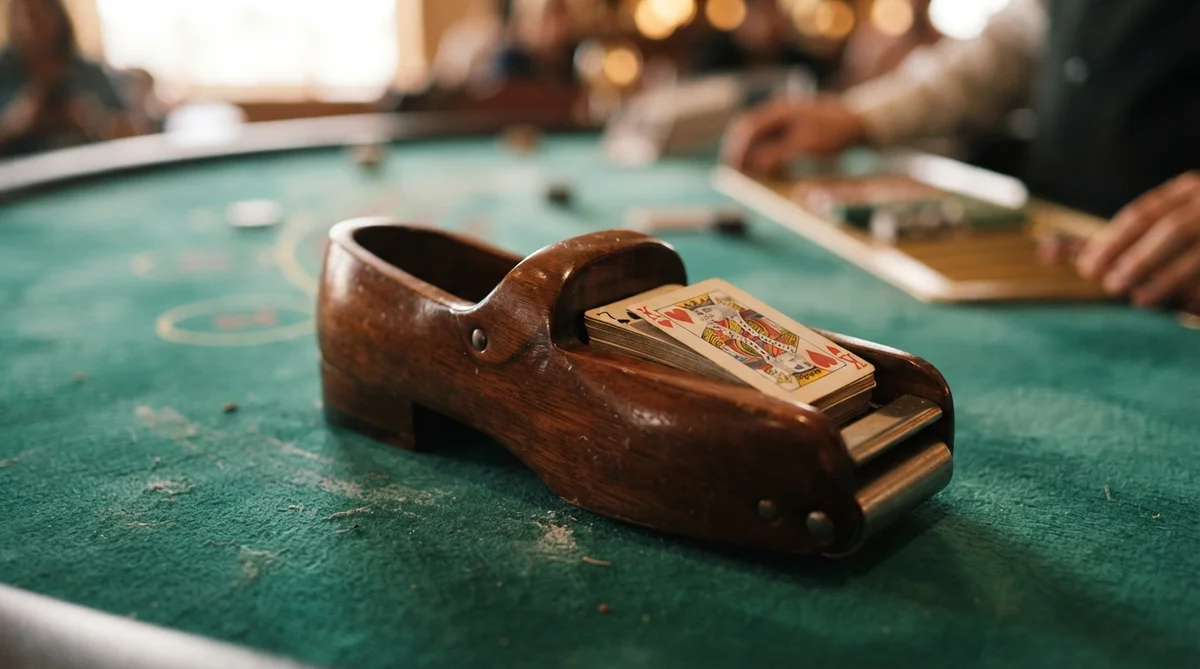
A standard casino table features semi-circular seating accommodating 1 to 7 players opposite a single dealer. Games use between 1 and 8 standard 52-card decks shuffled together inside a dealing shoe.
Before any cards are distributed, you must place an initial wager within posted table minimums and maximums. The dealer then distributes two cards to each player and two cards to the house position. Typically, player cards are dealt face-up, while the dealer receives one card face-up (the upcard) and one card face-down (the hole card).
How a Round Plays Out: Step-by-Step
Every round of blackjack follows a strict sequential progression from initial wager placement through hand settlement.
- Wager Placement: Players place chips into their designated betting spots before cards leave the shoe.
- Initial Deal: The dealer deals two cards to each active position and two to the house.
- Player Decisions: Players take turns acting on their hands from left to right relative to the dealer.
- Dealer Execution: The dealer reveals their hidden hole card and draws cards according to fixed table rules.
- Payout Resolution: Bets are collected or paid based on final hand comparisons.
Player Decisions During the Game
Once your two initial cards are dealt, you choose from several tactical options based on your point total and the dealer upcard.
- Hit: Draw an additional card from the shoe to increase your point total. You may hit multiple times until you stand or bust.
- Stand: Decline further cards and lock in your current point total to end your turn.
- Double Down: Double your initial wager in exchange for receiving exactly one additional card before automatically standing.
- Split: If dealt two cards of identical rank, double your wager to separate them into two independent hands played sequentially.
- Surrender: Forfeit half your stake and fold your hand immediately before making any other moves (offered at select tables).
Dealer Rules and Turn Progression
Unlike players, the dealer possesses zero decision-making autonomy. The dealer must adhere to fixed mechanical guidelines written directly on the table felt.
- Mandatory Hits: The dealer must draw additional cards whenever their point total is 16 or lower.
- Mandatory Stands: The dealer must stand whenever their point total reaches 17 or higher.
- Hole Card Peak: If the dealer’s upcard is an Ace or a 10-value card, they inspect the hidden card for an immediate natural blackjack.
Data from the UK Gambling Commission emphasizes that automated dealer draw constraints ensure complete administrative transparency across regulated physical and online venues.
Blackjack Payouts and Side Bets
Standard winning hands pay even money, whereas natural blackjacks carry enhanced returns. Optional side wagers offer higher fixed odds but carry substantially higher house advantages.
| Wager Type | Standard Payout | Winning Condition | Typical House Edge |
|---|---|---|---|
| Natural Blackjack | 3:2 | Dealt Ace + 10-value card on initial deal | 0.5% (Base Game) |
| Standard Win | 1:1 | Beat dealer total without exceeding 21 | 0.5% (Base Game) |
| Insurance Bet | 2:1 | Dealer holds natural blackjack with Ace up | 5.8% to 7.4% |
| Perfect Pairs | 5:1 to 30:1 | First two player cards form a pair | 5.8% to 13.0% |
| 21+3 Side Bet | 9:1 to 100:1 | Player cards + dealer upcard form poker hand | 3.2% to 8.6% |
How Does Blackjack Work to Maintain the House Edge?
The fundamental mechanism that secures the operator’s mathematical edge is sequential turn order. Players are required to complete their hands and potentially bust before the dealer acts.
If your hand count exceeds 21, your chips are collected immediately. Even if the dealer subsequently busts in the exact same round, your wager remains lost because your hand was eliminated first.
The Dealer’s Natural Advantage
If a player mimics dealer rules exactly by hitting until reaching 17 without splitting or doubling, the sequential bust penalty creates a baseline house advantage of roughly 8%. Statistically, both player and dealer bust on approximately 28% of hands. Because player busts lose instantly, the casino wins 100% of these simultaneous bust scenarios.
The availability of strategic player options like doubling down, splitting pairs, and receiving a 3:2 premium payout on natural blackjacks offsets most of this initial 8% gap.
How Rule Variations Change the House Edge
Casinos modify specific table conditions to adjust the baseline house advantage up or down. A full blackjack house edge explained analysis demonstrates how minor adjustments change expected return figures.
Research published by the Nevada Gaming Control Board highlights that minor structural shifts in payouts or deck counts significantly impact operational hold rates.
| Rule Variation | Structural Modification | Effect on House Edge |
|---|---|---|
| Blackjack Pays 6:5 | Reduces natural 21 payout from 1.5x to 1.2x | Increases house edge by +1.39% |
| Dealer Hits Soft 17 | Dealer draws on Ace-6 totals instead of standing | Increases house edge by +0.22% |
| 8 Decks vs 1 Deck | Increases card combinations in shoe | Increases house edge by +0.57% |
| Double After Split Allowed | Permits doubling down on split pairs | Decreases house edge by -0.14% |
Reducing House Edge with Basic Strategy
Basic strategy is a mathematically calculated matrix dictating the optimal move for every hand combination against every possible dealer upcard. Applying these basic rules of blackjack eliminates arbitrary guessing.
| Your Hand | Dealer Upcard | Optimal Action | Mathematical Rationale |
|---|---|---|---|
| Hard 12 to 16 | 2 through 6 | Stand | Dealer faces high probability of busting |
| Hard 12 to 16 | 7 through Ace | Hit | Dealer likely holds strong total (17 to 21) |
| Pair of Aces or 8s | Any card | Split | Breaks up weak 16 or starts two soft 11s |
| Hard 10 or 11 | 2 through 9/10 | Double Down | Maximises wager when 10-value draw is likely |
Executing basic strategy perfectly in a standard 6-deck 3:2 game lowers the house edge down to roughly 0.5%. Deviating from optimal play increases the casino’s expected retention over long sample sizes.